Define boundary conditions
Set recharge, coastal head, canal stage, and pumping terms for the scenario domain.
Coastal aquifer boundary-response model
A scenario-driven model for estimating hydraulic head, freshwater-saltwater interface depth, and well-level intrusion risk under variable recharge, sea-level, canal-stage, and pumping boundary conditions.
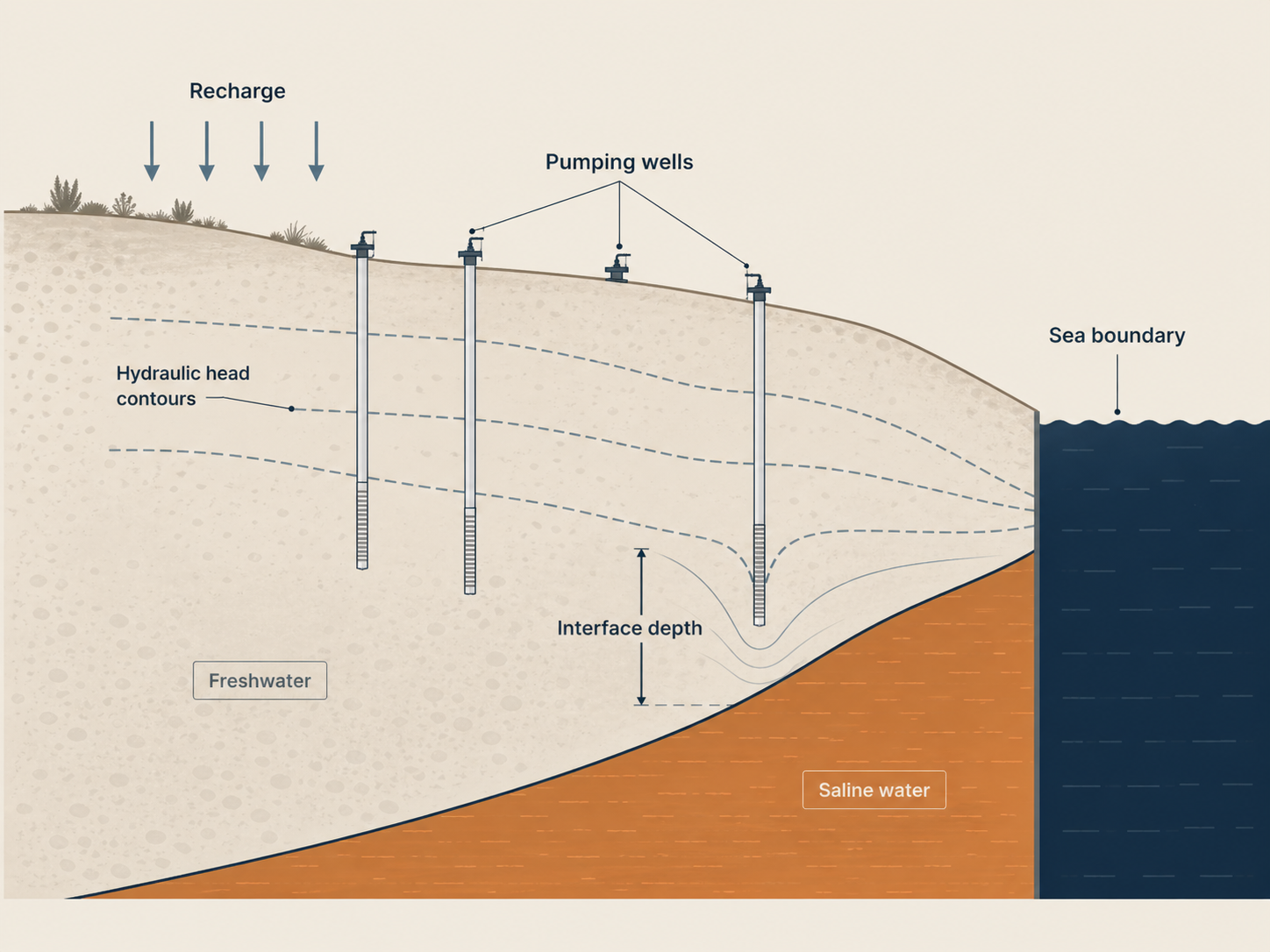
Numerical workflow
Halocline exposes each modeling step: boundary conditions are parameterized, the hydraulic head field is solved, interface position is estimated, and well-level intrusion risk is reported with diagnostics.
Set recharge, coastal head, canal stage, and pumping terms for the scenario domain.
Solve the steady-state Darcy flow field over the active grid and retain mass-balance diagnostics.
Use the Ghyben-Herzberg approximation to convert freshwater head into a sharp-interface depth estimate.
Estimate critical pumping and risk ratio for each placeholder wellfield under the solved head field.
Report convergence status, mass-balance residual, active guardrails, and non-regulatory model limitations.
Boundary model
The current model represents a two-dimensional active grid, fixed-head coastal and canal boundaries, distributed recharge, pumping wells, and a provisional aquifer-base clamp used for display.
Solves the two-dimensional steady-state Darcy flow equation over the active model grid.
Converts freshwater head to a sharp-interface estimate using the Ghyben-Herzberg approximation.
Computes well-level pumping stress, critical pumping, and risk ratio for each placeholder wellfield.
Scenario parameterization
Inputs combine scalar controls and spatial fields: recharge multiplier, coastal head, canal stages, well pumping, hydraulic conductivity, fixed-head masks, and active-cell geometry. Outputs are gridded head, estimated interface depth, scenario-baseline differences, and derived well risk metrics.
Inspect live map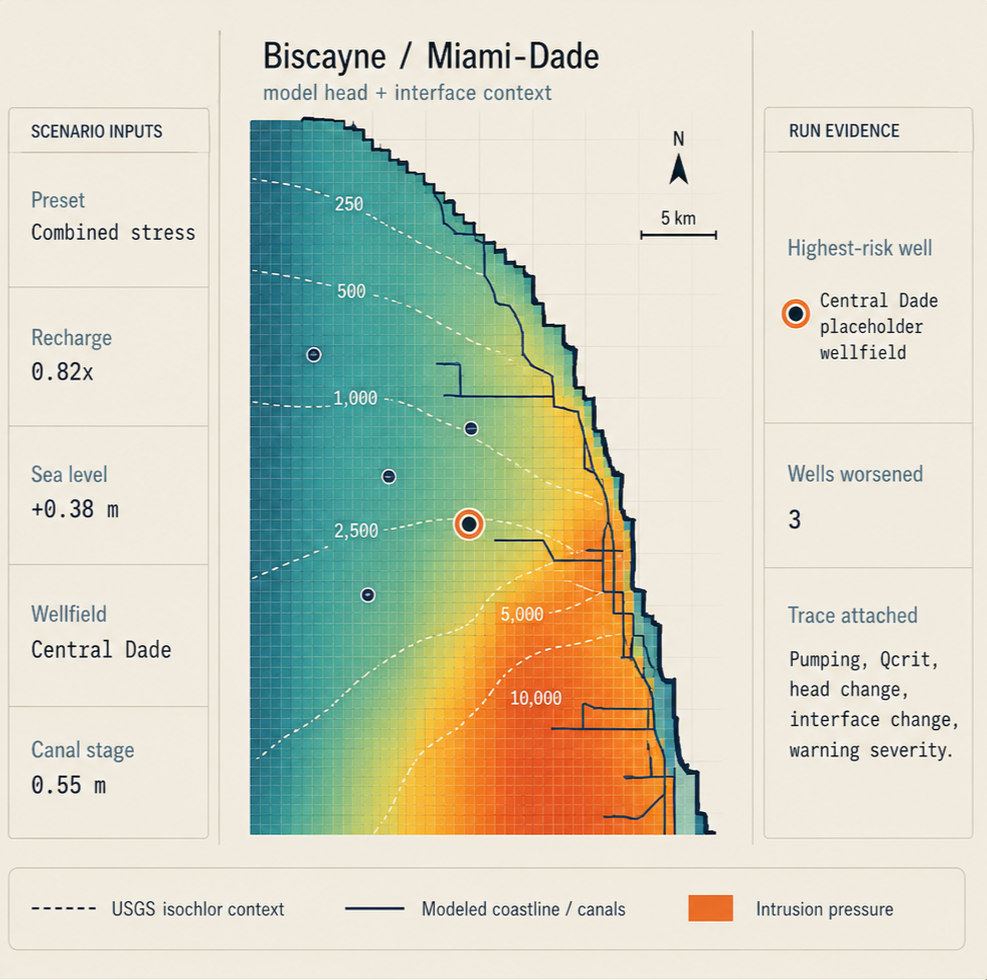
Evidence posture
The interface keeps source provenance, numerical diagnostics, warning conditions, and non-regulatory model status adjacent to the modeled outputs.
Reference layers identify agency source, access path, transformation, and Stage 1 limitations.
Controls expose recharge, pumping, canal stage, coastal head, and tuning values instead of hiding them behind a score.
Warnings and diagnostics distinguish model guardrails from observed field conditions and future calibration work.
Why the research track exists
Stage 1 keeps the calculation chain inspectable, but operational groundwater management eventually requires repeated high-fidelity calibration and uncertainty runs. The research track uses surrogate models to screen candidate scenarios before committing compute time to MODFLOW, SEAWAT, or PFLOTRAN-class simulators.
MODFLOW-family, SEAWAT, SUTRA, and PFLOTRAN-style workflows can represent subsurface physics more completely, but calibration, uncertainty quantification, and operational scenario sweeps require many repeated forward runs. Surrogates are useful only if they reduce that search space while preserving enough spatial structure to select the correct high-fidelity runs.
Research lineage
GeoFUSE pairs PFLOTRAN-generated seawater-intrusion simulations with U-FNO inference, PCA parameterization, and ESMDA data assimilation. Halocline uses that result as the research baseline while testing whether WNO and GNN methods can better preserve spatial heterogeneity.
Jiang, Liu, and Dwivedi integrate U-FNO, PCA, and ESMDA for seawater intrusion prediction and uncertainty reduction on a Beaver Creek cross-section.
arXiv 2410.20118The Fourier neural operator lineage supplies the fast operator approximation. GeoFUSE uses U-FNO, based on Wen et al. and Li et al., to estimate pressure and salinity fields.
Wen et al. 2022WNO brings localized multiresolution operators; graph-network surrogates bring mesh and connectivity awareness for wells, canals, faults, and irregular geology.
WNO referenceCurrent Halocline study
This was a compute and workflow test, not a MODFLOW/SEAWAT replacement and not a field-validated aquifer model. We rented GPU compute, generated synthetic oracle data from the Python Stage 1 solver, trained a U-FNO-style surrogate, and measured held-out error and inference speed.
Latin Hypercube samples varied recharge, sea-level rise, three placeholder well pumpings, eleven canal stages, and five calibration-lite tuning controls. Each sample was solved by the Python oracle and stored as HDF5.
Accuracy is measured against a simplified synthetic oracle, not observations. The oracle is a 2D steady sharp-interface model, not a calibrated MODFLOW, SEAWAT, or PFLOTRAN model. The surrogate accelerates this simplified oracle; it does not replace high-fidelity numerical simulation or site calibration.
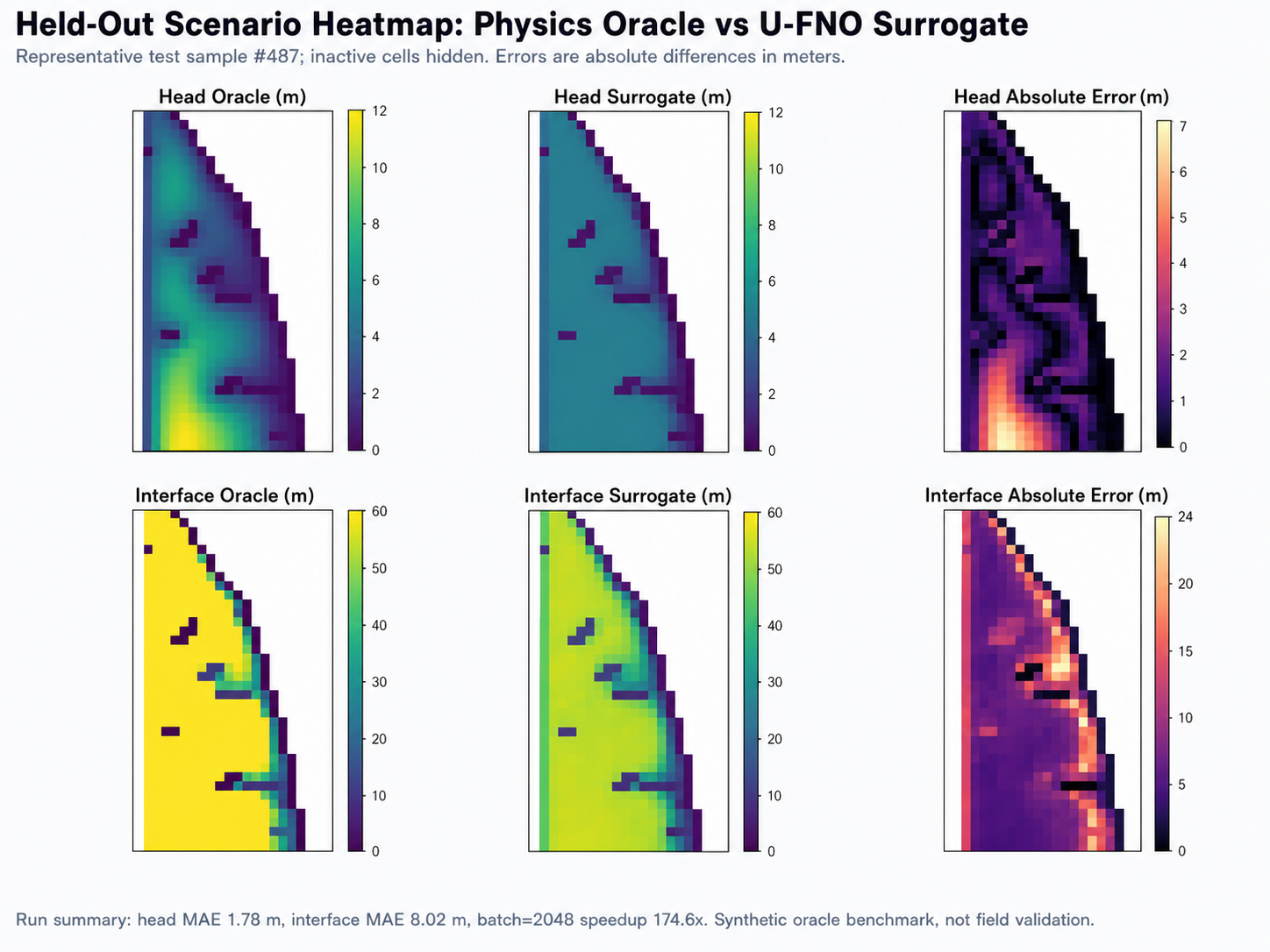
U-FNO prediction vs synthetic physics oracle (held-out test set). Summary metrics: head MAE 1.78 m, interface-depth MAE 8.02 m, batch-2048 inference speedup 174.57x versus the Python oracle.
Research direction
The next step is to test surrogate architectures that preserve spatial structure in high- and low-variance geologic zones, then use that speed to choose better MODFLOW, SEAWAT, or PFLOTRAN calibration runs.
Wavelet neural operators are attractive because wavelets can localize information across space and scale. That is the right failure mode to test when Fourier-style surrogates risk blurring sharp salinity fronts or high-variance hydraulic properties.
Graph surrogates can represent irregular cells, wells, canal links, boundaries, and local neighborhoods more naturally than a rectangular image alone. That matters as Halocline moves from Stage 1 grids toward utility and consultant model domains.
The practical target is a workflow where surrogate sweeps narrow thousands of candidates to the small set of scenarios and calibration runs that deserve full simulator time, shortening delivery from open-ended compute cycles to days or a week.
Working draft
The current product exposes the Stage 1 scenario calculation chain. The research track evaluates whether surrogate models can reduce the number of expensive simulator runs required for calibration and uncertainty analysis.